
CASE STUDY
AI-Powered Airline Customer Support System
An AI-powered support system that automates airline passenger queries using real-time flight data and a policy-grounded knowledge base — combining LLMs, PostgreSQL, and n8n workflows with safety guardrails for accurate, compliant answers.
Retrieval, knowledge (RAG), and orchestration working together
Every policy answer sourced from real documents, not model memory
Consistent, always-on coverage across the highest-volume query types
Complex cases escalate with full conversation context
The Challenge
Airlines receive thousands of customer queries daily — flight status checks, baggage inquiries, refund requests, booking changes. Traditional support depends heavily on manual responses, leading to longer resolution times and inconsistent experiences. The goal: design a system that responds to flight, delay, cancellation and baggage questions; combines real-time flight data (PostgreSQL) with policy information (a knowledge base) via Retrieval-Augmented Generation; filters input and output with guardrails for safety and compliance; and orchestrates multiple agents and tools through n8n.
How the System Works
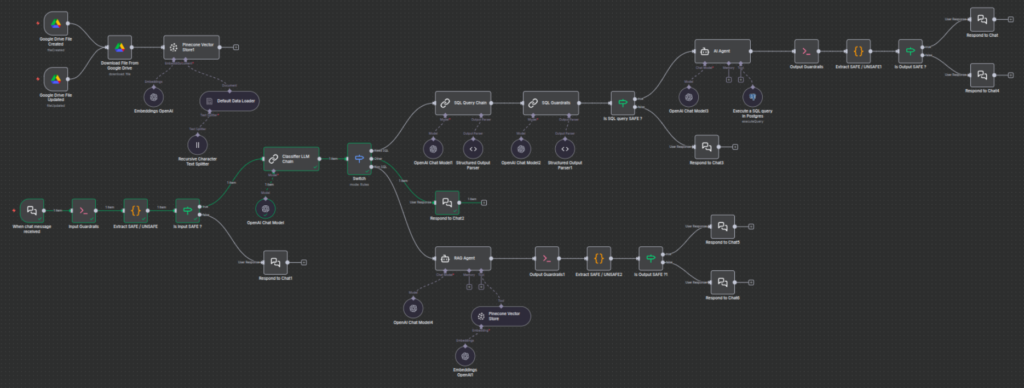
The system is built around three coordinated layers. A retrieval layer pulls live flight status, baggage, and booking data straight from PostgreSQL, so every answer reflects what is actually happening right now, not a static FAQ. A knowledge layer uses RAG to ground responses in the airline’s real policies — refund rules, baggage allowances, rebooking terms — instead of letting the model guess. An orchestration layer built on n8n ties these pieces together, routes each query to the right tool, and hands off to a human agent the moment a request falls outside safe, pre-approved boundaries. Every response passes through a guardrail layer before it reaches the passenger, blocking anything it cannot verify.
Key Capabilities
Real-Time Flight Answers
Status, delays, gate changes and cancellations pulled live from PostgreSQL.
Policy-Grounded Responses
Baggage, refund and rebooking answers sourced from the airline’s actual policy documents via RAG, not model memory.
Safety Guardrails
Automatic filtering of unsafe, non-compliant, or ungrounded responses before they reach a passenger.
Multi-Agent Orchestration
n8n coordinates specialised agents for status lookups, policy questions, and escalations.
Human Handoff
Complex or sensitive cases escalate with full conversation context, so passengers never repeat themselves.
24/7 Availability
Consistent, always-on coverage across the highest-volume query types airlines face daily.
Why This Approach Works
Airlines operate in a regulated environment where a wrong answer about refund eligibility or baggage policy has real consequences. Grounding every response in live data and verified policy documents through RAG is what keeps the system accurate. Combining that with an orchestration layer built on n8n workflow automation means the system can scale from simple status checks to multi-step booking changes without losing reliability.
Frequently Asked Questions
How does the system avoid giving passengers wrong information?
Every response is grounded in real-time data from PostgreSQL and the airline’s actual policy documents via RAG, rather than the model’s general knowledge. Guardrails block responses that aren’t sufficiently grounded before they reach the passenger.
Can it handle multi-step requests like rebooking a flight?
Yes. The n8n orchestration layer breaks multi-step requests into coordinated agent tasks — checking availability, applying fare rules, and confirming changes — rather than treating each request as an isolated one-off Q&A.
What happens when a passenger asks something outside the system's scope?
The system recognises when a query falls outside its safe, pre-approved boundaries and hands off to a human agent with full conversation context, so the passenger doesn’t have to repeat themselves.
What data sources does it integrate with?
In this build, PostgreSQL provides live flight and booking data, and a retrieval-based knowledge base holds policy documents. The same architecture can extend to CRMs, loyalty platforms, and existing airline booking systems.
How long does it take to build a system like this?
Timelines depend on how many data sources and workflows are involved. A focused single-use-case build like flight status and baggage queries typically takes a few weeks; full multi-agent systems with CRM and booking integration run longer.
Want an AI Support System Built for Your Business?
If your team handles high query volume — travel, logistics, financial services, or anywhere policy accuracy matters — we can design and build a guardrailed, RAG-grounded support system the same way we built this one.