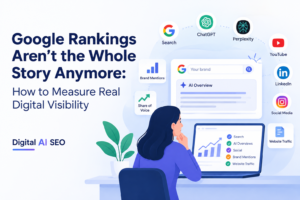
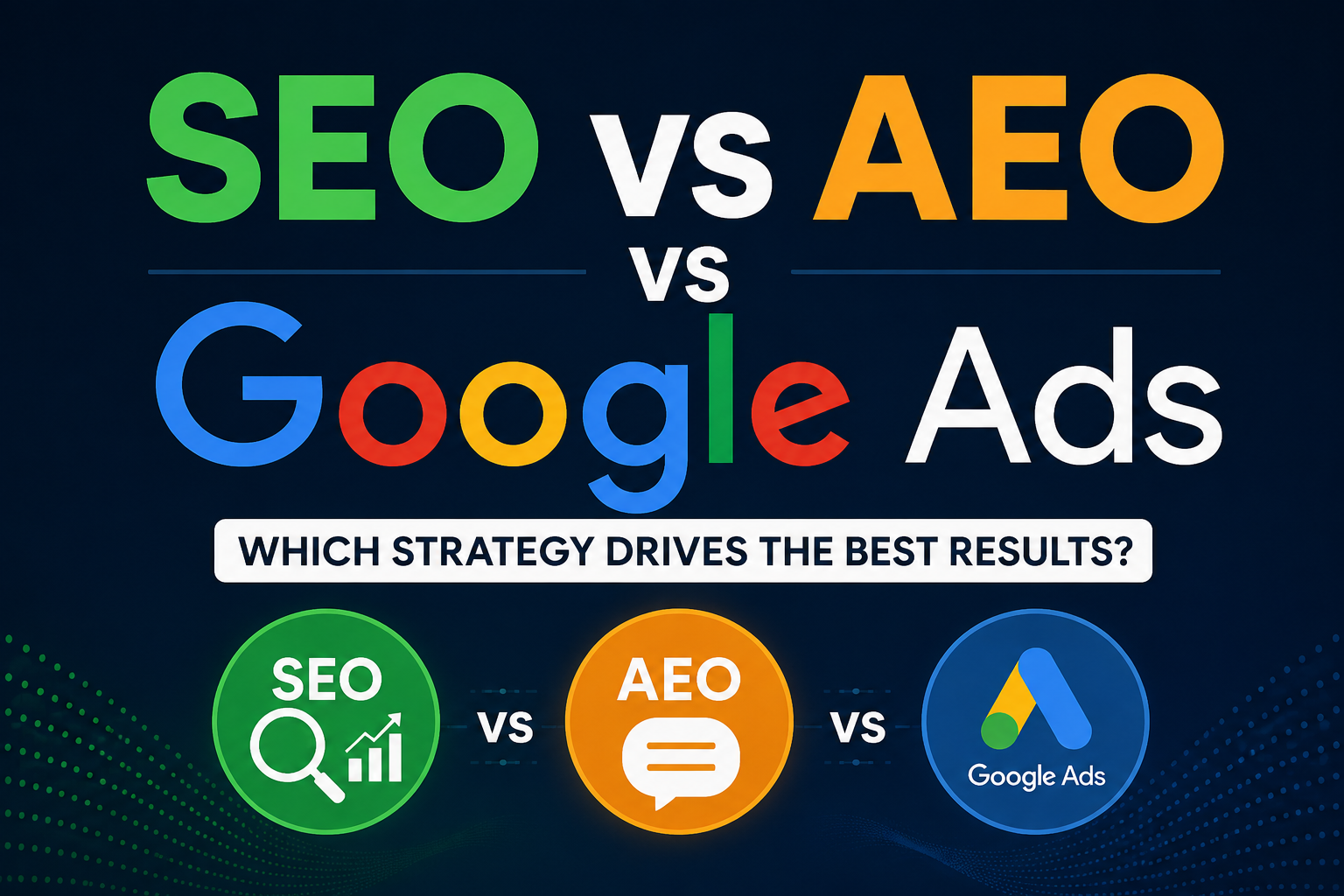

For years, “getting found online” mostly meant one thing: ranking on Google. Today, your buyer might find you three completely different ways in the same week — a Google search result, a paid ad, or a ChatGPT/Perplexity answer that recommends you by name without you ever seeing a click. Treating these as separate projects run by separate people is the single biggest reason businesses waste budget in 2026. Here’s how SEO, AEO, and Google Ads actually fit together — and how we approach all three, as shown in our Gwalior real estate SEO + GEO + AEO case study.
SEO: Still the Foundation, Not “Old News”
Search Engine Optimization hasn’t gone away — it’s still how the majority of organic discovery happens. But its job has shifted. SEO today does three things at once:
- Technical health — crawlability, site speed, mobile experience, structured data. This is the plumbing everything else depends on.
- Relevance — matching content to what people are actually typing into Google, not what you assume they’re typing.
- Trust signals — backlinks, reviews, consistent business information across the web (your Google Business Profile, directories, social profiles). This last point matters more than most businesses realize, because it feeds directly into AEO.
If your SEO foundation is weak, everything built on top of it — including AEO — is unstable. (See our AI SEO Services for how we approach this foundation.)
AEO: Optimizing for the Answer, Not Just the Click
Answer Engine Optimization is what SEO becomes when the “search engine” is an AI model rather than a list of ten blue links. (This is exactly what our GEO & AEO Services are built around.) When someone asks ChatGPT, Perplexity, or Google’s AI Overviews a question, the model isn’t ranking your page — it’s synthesizing an answer and deciding whether to mention you at all.
What actually moves the needle for AEO:
- Structure your content so it’s easy to extract. Clear headings, direct answers near the top of a section, and factual specifics (prices, timelines, credentials) rather than vague marketing language. AI models pull facts, not fluff.
- FAQ and Q&A formatting. Literally writing out the questions your customers ask, followed by direct answers, gives both Google’s “People Also Ask” and AI models something clean to lift.
- Corroboration across the web. This is the part most businesses miss entirely. AI models weigh consistency — the same facts about your business appearing on your site, your Google Business Profile, directories, and press mentions builds the kind of confidence that gets you cited. A single well-optimized page rarely gets quoted; a business that’s described the same way in five places often does.
- Schema markup. Structured data (Organization, FAQ, Product, LocalBusiness schema) doesn’t guarantee an AI citation, but it removes ambiguity about who you are and what you offer — which helps.
The honest caveat: AEO is younger and harder to measure than SEO. There’s no “AEO Search Console.” The most reliable way to track it today is manually testing the questions your buyers would actually ask, across ChatGPT, Perplexity, and Google AI Overviews, and logging whether you show up — repeated monthly, not once.
Google Ads: The Channel You Control Completely
SEO and AEO both take time and neither guarantees a result — you’re influencing an algorithm you don’t control. Google Ads is the opposite: pay, and you’re visible today, for exactly the terms you choose.
That’s precisely why it pairs well with the other two rather than competing with them:
- Speed while SEO/AEO builds. Organic rankings and AI citations can take months. Ads fill that gap immediately.
- Data that improves the other two. Search term reports from Ads campaigns are one of the best sources of real buyer language — feed that straight back into your SEO content and AEO-style FAQ pages.
- Retargeting the people SEO/AEO brought halfway there. Someone who found you through an AI Overview or organic search but didn’t convert is a warmer retargeting audience than a cold one.
The mistake to avoid: running Ads with no negative keyword hygiene and sending all traffic to a generic homepage. That’s the fastest way to pay a high cost-per-lead for unqualified clicks — a pattern we see constantly with businesses that treat Ads as “set it and forget it.”
How to Actually Sequence This
If you’re starting from scratch, here’s a reasonable order of operations:
- Fix technical SEO first — a slow, unindexed, or poorly structured site undermines Ads landing pages and AI extractability alike.
- Launch Ads in parallel for immediate visibility on your highest-intent keywords, with dedicated landing pages, not the homepage.
- Build AEO-structured content — FAQ pages, schema, and consistent business information across directories — as your organic content library grows.
- Track AI citations monthly and treat gaps as a content and corroboration problem, not a mystery.
The Bottom Line
SEO earns long-term organic visibility. AEO earns visibility inside the AI tools an increasing share of buyers now research with. Google Ads buys visibility today while the other two compound. Businesses that pick one and ignore the others are optimizing for how people searched five years ago — not how they’re searching now.
Curious what this looks like with real numbers? Our Gwalior real estate case study walks through exactly this playbook — SEO, GEO, AEO, Google Ads, and social — for one client over 8 months.
Frequently Asked Questions
What is AEO (Answer Engine Optimization)?
AEO is the practice of structuring your content so AI tools like ChatGPT, Perplexity, and Google AI Overviews can accurately extract and cite it when answering a user’s question — as opposed to traditional SEO, which optimizes for ranking in a list of search results.
Is AEO replacing SEO?
No. AEO builds on SEO rather than replacing it — a technically sound, well-structured, trustworthy site is still the foundation both traditional search rankings and AI citations depend on.
How is AEO different from GEO (Generative Engine Optimization)?
The terms are largely used interchangeably in the industry today. Both describe optimizing content and business information so generative AI tools surface and cite your business accurately.
How do I know if my business is being cited by AI tools?
There’s no equivalent of Google Search Console for AI citations yet. The most reliable method is manually testing the real questions your buyers would ask — across ChatGPT, Perplexity, and Google AI Overviews — and tracking the results monthly.
Should I run Google Ads while building SEO and AEO?
Yes, generally. SEO and AEO take months to compound; Google Ads gives you visibility immediately and, if set up with proper landing pages and negative keywords, produces buyer-language data that improves your organic and AEO content in return.
How long does it take to see AEO results?
It varies by market and competition, but expect a similar timeline to SEO — meaningful AI citation gains typically show up over 3–6 months of consistent, structured content and cross-platform business consistency, not overnight.