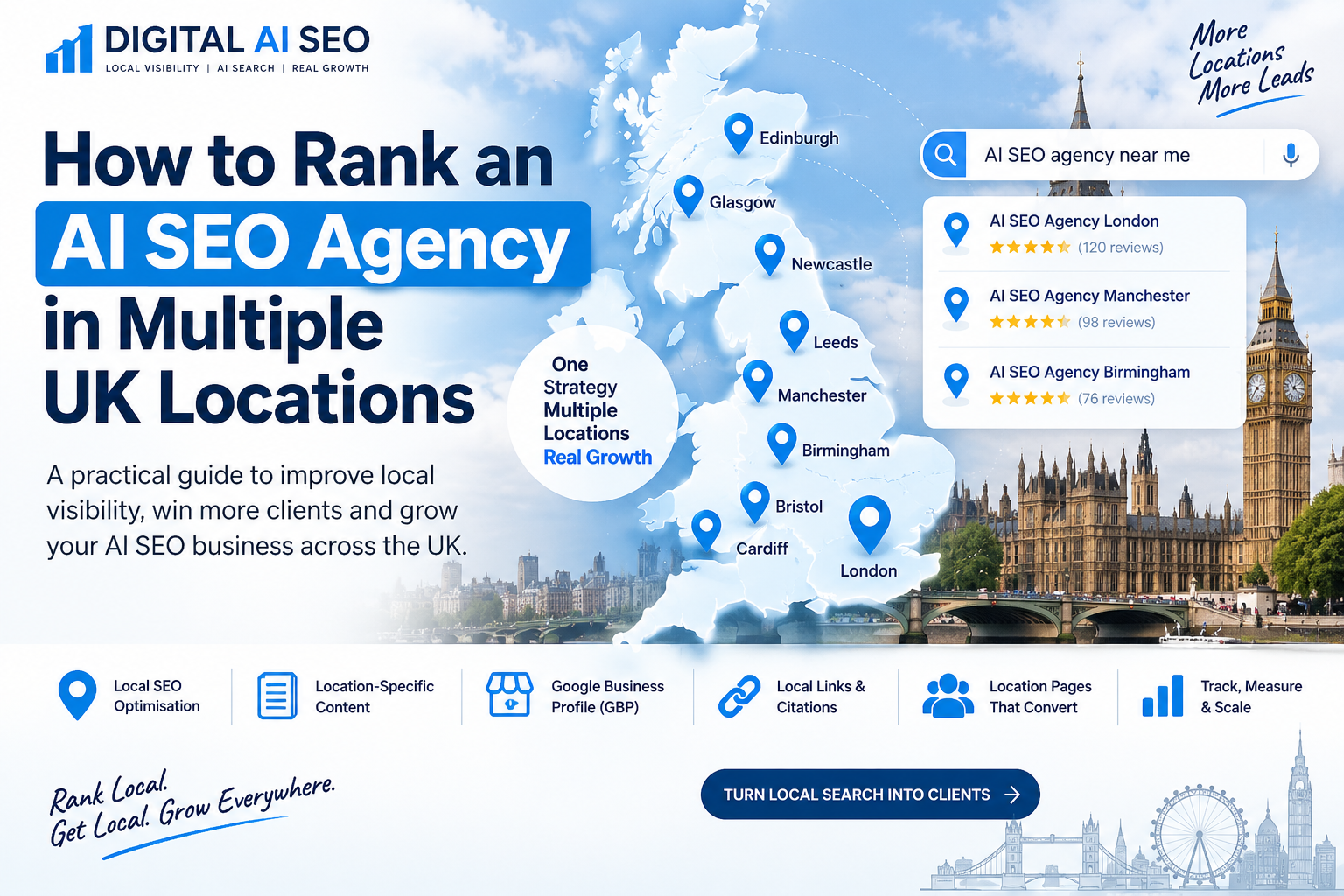

If you run an AI SEO agency and you’re only ranking well in one city, you’re leaving money on the table. UK businesses search locally — “AI SEO agency Manchester,” “AI SEO consultant Leeds,” “best AI-powered SEO company London” — and Google rewards agencies that can prove genuine local relevance in each of those markets, not just a national footprint with a few city names sprinkled into a footer.
Ranking in multiple UK locations at once is a different problem from ranking nationally. It requires a deliberate structure across your website, your Google Business Profiles, your content, and your backlink strategy. Here’s how to build it properly.
1. Build a Scalable Location Page Structure
The foundation of multi-location SEO is a clean, crawlable URL structure — not a single “Areas We Cover” page with a bullet list of forty towns.
Recommended structure:
https://digitalaiseo.com/locations/manchester/
https://digitalaiseo.com/locations/leeds/
https://digitalaiseo.com/locations/birmingham/
Each location page needs to be a genuinely useful page, not a thin clone with the city name swapped out. Google’s algorithms are very good at spotting templated “doorway pages” that exist purely to rank, and they get filtered out or penalised.
For each location page, include:
- A unique introduction explaining why your AI SEO services matter to that specific market (mention known local business sectors — e.g., manufacturing in Birmingham, fintech in Edinburgh, tourism in Bristol)
- Case studies or results specific to clients in or near that city
- Local testimonials, if available
- A local phone number or contact route where possible
- An embedded map and clear NAP (Name, Address, Phone) details
- FAQs addressing location-specific questions (“Do you work with Manchester retail brands?”)
Avoid duplicating the same paragraph structure across every page with only the city name changed — vary sentence order, examples, and emphasis for each one.
2. Set Up (and Properly Optimise) Google Business Profiles
If you have a genuine physical presence — an office, a co-working membership, a registered address — in more than one city, a Google Business Profile (GBP) for each location is one of the strongest ranking levers available.
- Use consistent NAP data across your website, GBP, and all directory listings
- Select the most accurate primary and secondary categories (e.g., “Internet Marketing Service,” “Marketing Consultant”)
- Write a unique business description for each profile referencing the specific city and services offered there
- Post regularly — case studies, service updates, and testimonials — to each profile
- Collect and respond to reviews consistently; review velocity and recency matter more than raw volume
If you don’t have a true physical office in a city, do not create a fake or virtual-address GBP listing. Google actively penalises this, and it can get your entire account suspended. In that case, rely on strong location pages, local content, and service-area targeting instead of a GBP listing for that city.
3. Create Location-Specific Content, Not Just Location-Specific Pages
Service pages establish that you operate somewhere. Content proves you understand the market. A monthly content cadence built around local SEO trends strengthens your topical and geographic authority simultaneously.
Ideas that work well for an AI SEO agency:
- “How [City] Businesses Are Using AI for Local Search in 2026”
- Local case studies with real (anonymised, if needed) metrics
- Commentary on regional search trends (retail in Leeds vs. professional services in London)
- Guides tailored to local sectors — hospitality SEO in Brighton, B2B SEO in Reading, etc.
This content should link back to the relevant location page, reinforcing the internal linking structure Google uses to understand geographic relevance.
4. Build Location-Relevant Backlinks and Citations
Domain authority alone won’t rank you locally — you need signals that tie your agency to each specific place.
- Local directories: Get listed accurately on major UK directories (Yell, Thomson Local, Cylex) and industry-specific listings
- Local press and PR: Regional business publications, local Chamber of Commerce features, and startup/tech hub write-ups carry strong local relevance signals
- Sponsorships and partnerships: Sponsoring a local event, meetup, or industry group often earns a natural, relevant backlink
- Guest content on regional business blogs: A well-placed guest article on a Manchester business blog does more for your Manchester rankings than ten generic national backlinks
5. Structure Your Site Architecture for Multi-Location Clarity
Search engines need to understand which pages represent which locations without ambiguity.
- Use schema markup (LocalBusiness or ProfessionalService schema) on each location page, with correct address, geo-coordinates, and service area data
- Implement clear internal linking from the homepage and main navigation to every location page — don’t bury them
- If you serve areas without an office, use “service area business” schema and language (“serving Sheffield and surrounding areas”) rather than implying a physical office you don’t have
- Keep a single, canonical URL per location — avoid duplicate or near-duplicate pages targeting the same city
6. Track Rankings and Visibility by City, Not Just Nationally
A national rank tracker will hide the fact that you’re invisible in three out of five target cities. Use local rank tracking tools (Local Falcon, BrightLocal, or similar) that show visibility across a “grid” of search points within each city, particularly for Google’s Local Pack results.
Review monthly:
- Local Pack (map) rankings for your core keywords in each city
- Organic rankings for location-modified keywords (“AI SEO agency + city”)
- GBP insights: calls, direction requests, and profile views per location
- Conversion rate by location, so you can prioritise the cities that actually convert
7. Avoid the Common Multi-Location SEO Mistakes
- Thin, duplicated location pages — the single biggest reason multi-location SEO efforts fail
- Fake or virtual GBP listings in cities with no real presence
- Inconsistent NAP data across the web, which confuses Google’s local relevance algorithms
- Ignoring mobile and voice search — a large share of local searches happen on mobile with “near me” phrasing
- Treating every city identically — sector mix, competition level, and search behaviour vary significantly between, say, London and a mid-sized regional city, and your content and offer should reflect that
Conclusion
Ranking an AI SEO agency across multiple UK locations isn’t about cloning a template city after city — it’s about building genuine, differentiated relevance in each market: unique pages, accurate business listings, locally resonant content, and location-specific backlinks, all wrapped in clean technical architecture. Agencies that treat each city as its own micro-market, rather than a line item on a coverage list, are the ones that consistently show up in local packs across the country.
Want help auditing your current location pages or building out a multi-location content plan? That’s exactly the kind of project an AI-powered SEO workflow can speed up significantly.