
Indian search behavior is shifting fast — more people are asking ChatGPT and Google’s AI Overviews questions they used to type into a search box. That doesn’t make traditional SEO useless. It means Indian businesses now need both, and it helps to understand exactly where each one matters.
A Quick History: How We Got Here
For two decades, SEO meant one thing: rank on Google’s results page. Businesses optimized for keywords, built backlinks, and competed for the top spot. That playbook worked because there was one dominant place people searched. Now there are several — Google Search, Google AI Overviews, ChatGPT, Gemini, Perplexity — and each surfaces information differently. The fundamentals of trust and clarity still matter everywhere, but how that trust gets demonstrated has split into two related but distinct disciplines.
What Traditional SEO Still Does Right
Technical foundations, keyword targeting, and genuine backlinks are still what get your site indexed, crawled, and trusted in the first place. None of that goes away — AI SEO builds on top of it, not instead of it. A site with broken technical SEO (slow load times, poor mobile experience, thin content) struggles to earn AI citations for the exact same reasons it struggles to rank on Google: neither system trusts a page that’s hard to access or poorly structured.
What’s New: AI SEO and GEO
Generative Engine Optimization (GEO) is about getting mentioned inside an AI-generated answer, not just ranked on a results page. There’s no “page one” in a chat response — you’re either part of the answer, or invisible to that customer. We covered exactly how this works in our GEO guide for Indian businesses, including the practical steps to start improving it.
Do You Need Both?
Yes. A technically weak site won’t rank in Google or get cited by AI models — both depend on the same foundation of clarity, structure, and trust, then diverge in how that trust gets demonstrated (backlinks and keyword relevance vs. structured, citable, FAQ-style content). Treating them as competing priorities usually means underinvesting in both.
A Quick Self-Check
- Do you have clear FAQ content answering the exact questions your customers ask?
- Is your site technically healthy (fast, mobile-friendly, properly indexed)?
- Have you ever checked whether ChatGPT or Gemini mentions your business at all?
- Is your business information consistent across your website, directories, and social profiles?
If you answered no to any of these, that’s a real gap worth addressing before it costs you customers who are already searching this way.
What This Looks Like for an Indian Startup Specifically
If you’re earlier-stage and resource-constrained, prioritize based on where your actual customers already are. Younger, urban, tech-adjacent audiences skew more toward AI-assisted research; more traditional or older demographics may still search Google directly. Most Indian businesses serve some mix of both, which is exactly why neither can be ignored. Our guide on AI automation for Indian startups covers a related question — how to prioritize limited resources when everything feels urgent at once.
How We Cover Both
Our AI SEO Services cover technical SEO and AI visibility together rather than treating them as separate line items, and our AI Visibility Tool shows you where you stand today on the AI side specifically. Start a project for a free assessment.
A Side-by-Side Way to Think About It
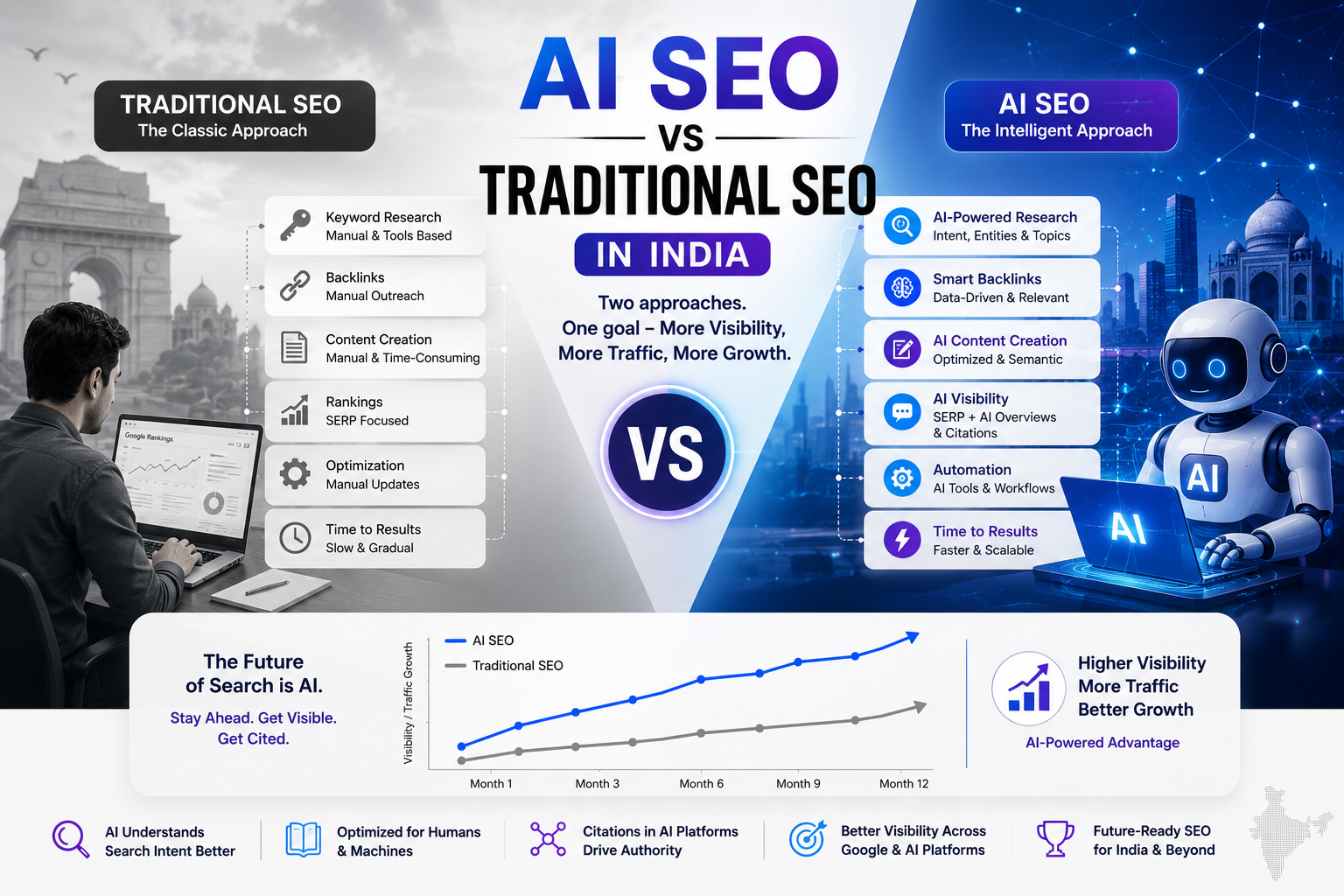
Traditional SEO answers the question “how do I get my page to rank higher on a results page.” AI SEO (including GEO) answers a related but distinct question: “how do I get mentioned when someone asks an AI model directly, with no results page involved at all.” Traditional SEO rewards keyword relevance, backlink authority, and technical performance measured over time through rankings. AI visibility rewards clarity, structured factual content, and consistency, measured through citation and mention rate rather than position.
What Changes in How You Write Content
Writing for both means shifting some habits. Traditional SEO content often front-loads keywords and builds toward a conclusion. Content that performs well for AI citation tends to lead with the direct, factual answer first, formatted so it can be lifted cleanly — similar to how a well-written FAQ answer works. This doesn’t mean abandoning keyword strategy; it means adding directness and structure on top of it, not instead of it.
A Common Misconception Worth Addressing
Some business owners assume that once AI search becomes dominant, traditional rankings won’t matter at all. In practice, AI models frequently draw from and cite well-ranking, authoritative pages as part of how they build trust in a source — the two systems aren’t fully separate. A page that never ranked well on Google is also less likely to be considered a trustworthy source by an AI model crawling and evaluating the same web.
Budgeting Across Both: A Practical Split
Businesses often ask how to split a limited marketing budget between the two. A reasonable starting approach: keep technical SEO and core content investment steady (this remains the foundation regardless of AI trends), then layer AI-specific work — FAQ structuring, schema markup, citation tracking — on top rather than diverting budget away from fundamentals. Cutting technical SEO spend to chase AI visibility usually backfires, since AI trust signals lean on the same foundation.
Industries Where This Shift Matters Most Right Now
Not every industry feels this shift equally yet. Service businesses, SaaS products, and consumer goods with active comparison-shopping behavior (where people genuinely ask “what’s the best X for Y”) see AI-driven research happening today. More transactional, price-driven categories may see traditional search remain dominant a while longer. Understanding where your specific customers are in this shift helps prioritize effort realistically rather than chasing every trend uniformly.
Frequently Asked Questions
Is traditional SEO dead now that AI search exists?
No. Technical SEO foundations, keyword targeting, and backlinks still determine whether your site gets indexed and trusted — AI SEO builds on top of that, it doesn’t replace it.
What is GEO, and is it different from AI SEO?
GEO (Generative Engine Optimization) is essentially the AI-visibility half of AI SEO — getting mentioned inside AI-generated answers specifically. See our full GEO guide for details.
How do I know if my business is missing out on AI visibility?
Try asking ChatGPT or Gemini a question your business could answer and see if you’re mentioned. Our AI Visibility Tool tracks this more systematically over time.
Should Indian businesses prioritize AI SEO over traditional SEO?
Neither should be skipped — they work together. Prioritizing depends on your current gaps and where your specific customers actually search, which is why a proper audit matters before deciding where to focus first.
Does a technically weak website hurt AI visibility too, not just Google rankings?
Yes. AI models are less likely to trust and cite a site that’s slow, poorly structured, or hard to crawl — the same technical issues that hurt traditional rankings also hurt AI citation chances.
How do I get both covered properly?
Our AI SEO Services are built to handle technical SEO and AI visibility together. Start a project for a free assessment.