

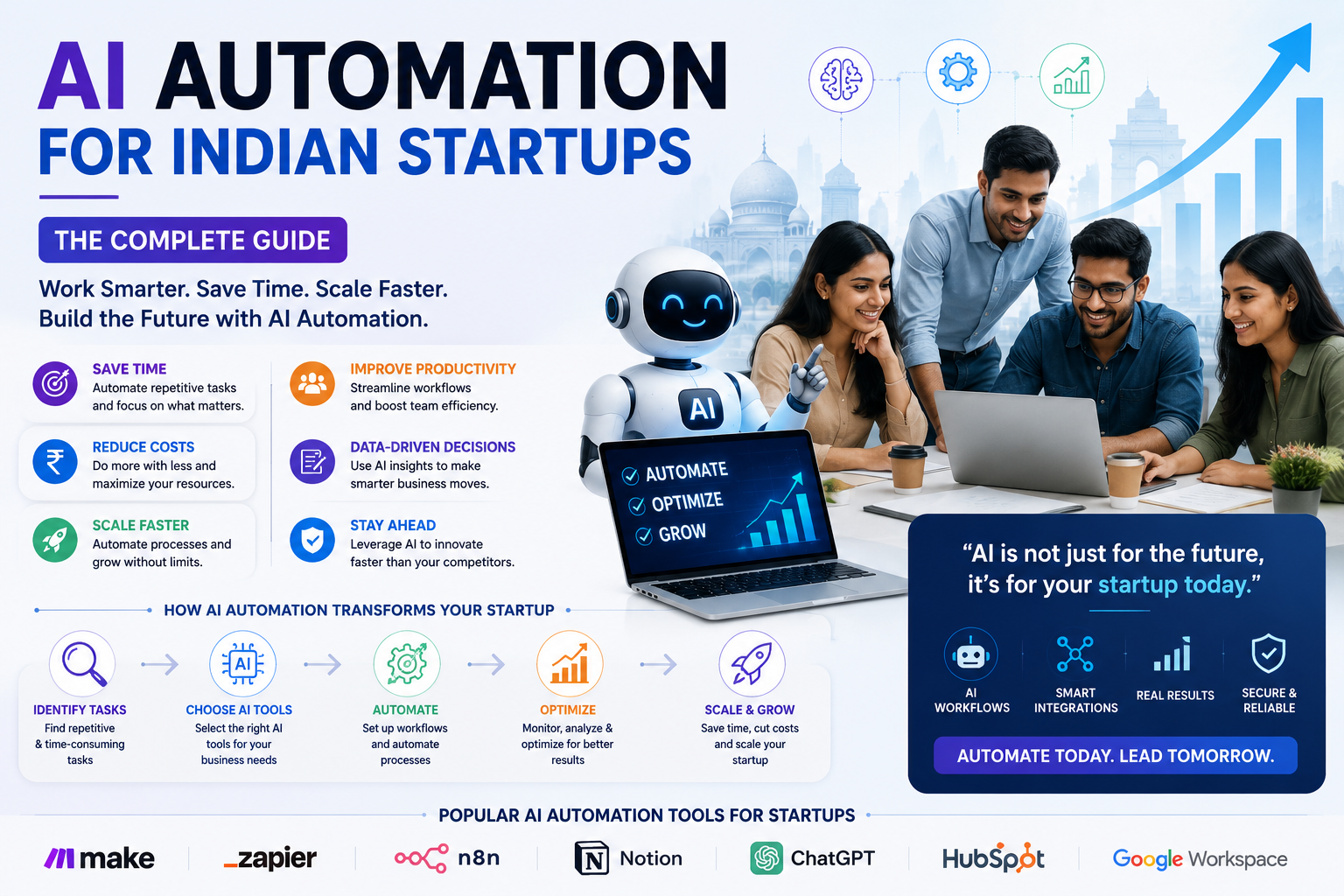

Most Indian founders hear “AI automation” and picture something built for companies with 10x their budget and an in-house engineering team. In practice, some of the highest-value automation is small, scoped, and affordable — and getting it right early saves you from hiring support staff you don’t need yet, or from customer experience gaps that quietly cost you deals.
Why Startups Delay Automation (And Why That’s a Mistake)
The usual reasoning goes: “we’re too small for AI automation, we’ll revisit this once we scale.” But the repetitive work — answering the same five customer questions over and over, manually qualifying every inbound lead, routing support tickets by hand — doesn’t get easier at a bigger size, it gets worse. Fixing it early, while your workflows are still simple, is far cheaper than retrofitting automation onto a messier process later.
Where Startups Should Actually Start
Don’t start with “automate everything.” Start with the one repetitive task eating the most founder or team time — usually customer queries, lead qualification, or routing support tickets. Our Agentic AI & Automation services are built around exactly this kind of scoped, single-workflow automation first, rather than a sweeping overhaul that’s harder to test and trust.
Common Mistakes We See Indian Startups Make
- Buying a tool instead of solving a workflow — a shiny AI tool doesn’t help if it doesn’t fit how your team actually works. Founders sometimes purchase a subscription because a tool looked impressive in a demo, then it sits unused because it doesn’t match their actual process.
- Skipping data grounding — an agent that answers from the model’s memory instead of your real data will eventually give a customer a wrong or made-up answer, which is far more damaging to trust than a slow human response would have been.
- Ignoring integration cost — the agent itself might be simple; connecting it cleanly to your existing tools (CRM, WhatsApp, email) is usually where the real work is, and where budgets get underestimated.
- No plan for what happens when it’s wrong — automation without a human fallback path for edge cases creates a worse experience than no automation at all.
A Realistic First Project
A good starting point looks like automating repetitive customer queries, similar to a workflow we built using n8n — scoped, testable, and useful within weeks rather than months. The goal of a first project isn’t to automate 100% of a workflow; it’s to prove the approach works and build organizational trust in AI-assisted processes before expanding further.
What Should You Budget?
Cost depends heavily on the number of integrations and data sources involved, which is why we don’t publish fixed packages. See our honest pricing approach for how we quote projects. As a general principle, a single well-scoped workflow costs meaningfully less than a multi-agent system spanning several departments — which is exactly why starting small and proving value first is the smarter path for most early-stage startups.
How This Fits Into Your Broader Growth Strategy
Automation and visibility work well together — as your automated support and lead-handling frees up founder time, that same time can go toward the content and SEO work that brings in more leads in the first place. Our AI SEO Services and this automation work are designed to complement each other rather than compete for the same budget.
Getting Started
Start a project and tell us about your startup — we’ll help you figure out where automation actually pays off first.
A Realistic Example: Support Automation for an Early-Stage Startup
Picture a 5-person D2C startup fielding 40-50 repetitive customer questions a day — order status, return policy, sizing, shipping timelines. Before automation, this eats a significant chunk of a founder or ops person’s day, every day. A scoped RAG-grounded agent trained on the actual return policy, size chart, and shipping documentation can handle the majority of these directly, escalating only genuinely unusual cases. The founder gets hours back weekly, and customers get instant answers instead of waiting for business hours — without needing a full customer support hire at this stage.
When You Should NOT Automate Yet
Automation isn’t always the right first move. If your workflow itself is still changing week to week (common in very early-stage startups still finding product-market fit), automating a process that will look different in a month often means rebuilding it soon after. It’s usually better to let a workflow stabilize with a human doing it manually first, then automate once the pattern is consistent and well-understood.
Measuring Whether It’s Actually Working
Don’t just assume automation is helping — track it. Simple metrics like how many queries the agent resolves without escalation, average response time, and customer satisfaction on automated vs. human-handled queries tell you whether the investment is paying off, and where to improve next.
Choosing Between Building In-House vs. Hiring Help
Some technical founders are tempted to build automation themselves using off-the-shelf tools. This can work for very simple cases, but the gap usually shows up in reliability — handling edge cases, grounding responses properly, and maintaining the system as your product or policies change. Weigh the founder’s time cost of building and maintaining it in-house against the cost of a properly scoped external build; for many early-stage teams, the founder’s time is better spent on the product and customers than on maintaining automation infrastructure.
Scaling Beyond the First Workflow
Once your first automated workflow proves itself, the natural next step is expanding to adjacent processes — lead qualification feeding into your CRM, or automated follow-ups for abandoned carts. The key is expanding one proven workflow at a time rather than attempting several simultaneously, since each new integration adds real complexity that’s easier to manage incrementally.
Frequently Asked Questions
Is AI automation affordable for early-stage Indian startups?
Yes, if scoped correctly. Starting with one specific workflow (like customer query handling) is far more affordable than trying to automate everything at once.
What should a startup automate first?
Whatever repetitive task is eating the most time — usually customer support queries, lead qualification, or ticket routing.
How do I stop an AI agent from giving customers wrong answers?
Ground it in your real documents and data using RAG (Retrieval-Augmented Generation), rather than relying on the AI model’s general knowledge alone.
Do I need in-house developers to maintain an AI agent?
Not necessarily. Agents can be visually managed, and ongoing support can be handled by the team that builds them for you.
What's the biggest budgeting mistake startups make with automation?
Underestimating integration cost — connecting an agent cleanly to existing tools like a CRM or WhatsApp is often more work than the agent logic itself.
How do I know if my startup is ready for this?
If you have a clear, repetitive workflow and real data to ground the agent in, you’re ready to start small. Start a project for a free assessment.