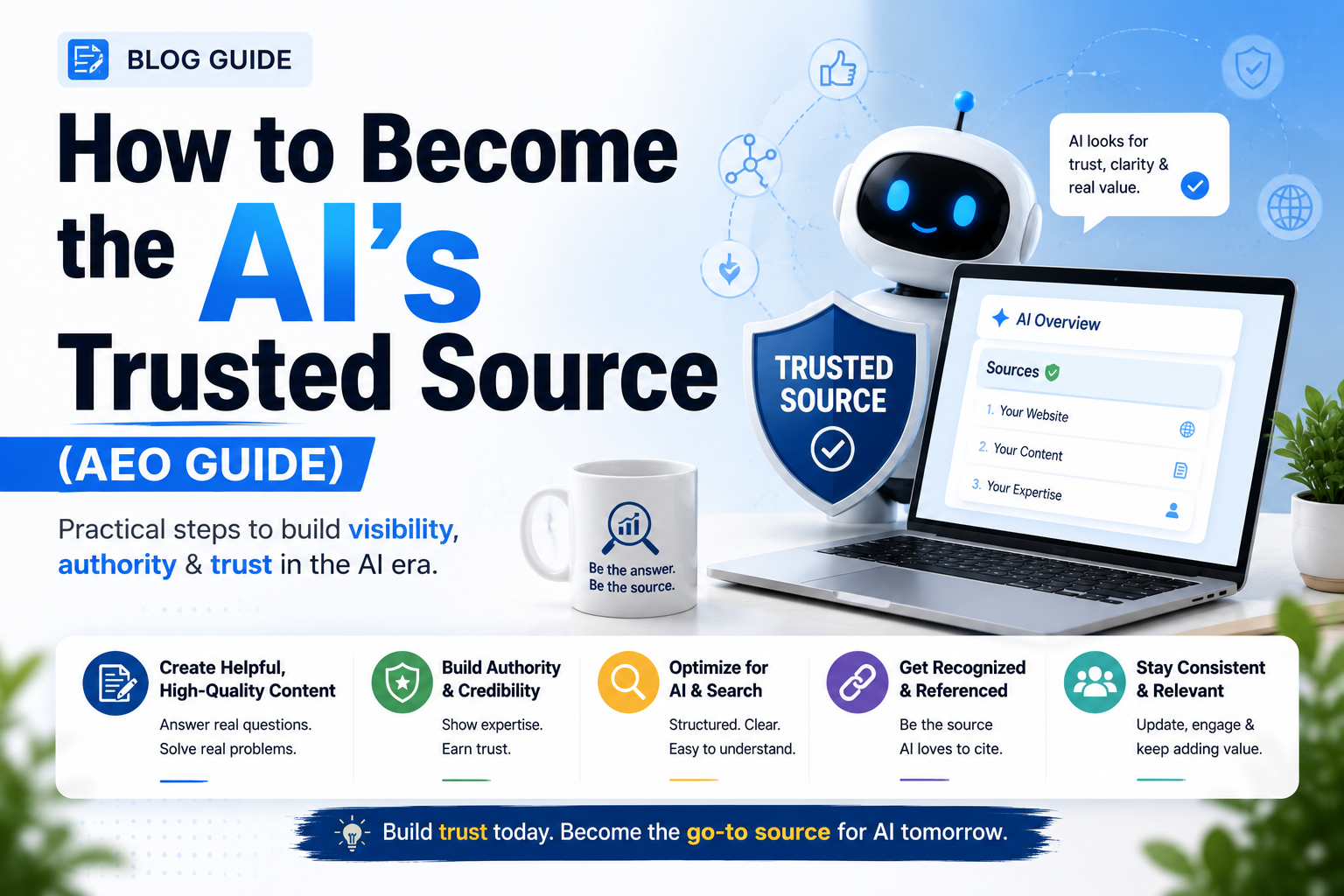

Every AI search term flying around right now — AEO, GEO, LLM SEO, AI Search Optimization — is really describing the same underlying shift: AI models like ChatGPT, Gemini, and Google’s AI Mode are becoming a new kind of gatekeeper between your business and your customers. Whether you call it Answer Engine Optimization (AEO) or Generative Engine Optimization (GEO), the real question is the same: how does your business become a source these systems actually trust and cite?
What Is AEO (Answer Engine Optimization)?
AEO is the practice of structuring your content so AI-powered “answer engines” — ChatGPT, Gemini, Perplexity, Google AI Mode, and AI Overviews — can understand, trust, and directly cite it when responding to a user’s question. Traditional SEO optimizes for a ranked list of links. AEO optimizes for being the actual source of the answer itself, often with no link click required at all.
AEO vs. GEO vs. LLM SEO: Same Shift, Different Names
You’ll see this discipline called several different things, and the terminology is still settling:
- AEO (Answer Engine Optimization) — emphasizes optimizing for direct answers, often associated with voice search and featured snippets historically, now extended to AI chat answers.
- GEO (Generative Engine Optimization) — emphasizes optimizing specifically for generative AI models that synthesize answers from multiple sources, like ChatGPT and Gemini.
- LLM SEO — a more technical framing, focused on how large language models specifically retrieve and weight information.
- Google AI Mode SEO — the same principles applied specifically to Google’s AI-powered search experience, which blends traditional ranking signals with generative answers.
In practice, these terms overlap heavily, and the underlying work is largely the same: clear, structured, trustworthy content that both traditional search engines and AI models can confidently use. We use “AEO” and “GEO” somewhat interchangeably in our own work, and cover the traditional-SEO side of this comparison in AI SEO vs Traditional SEO.
Why “Trusted Source” Is the Right Way to Think About This
Ranking is a competition for position. Being a trusted source is a competition for confidence. AI models don’t show you a ranked list they’re unsure about — they synthesize a single answer, which means they’re making an implicit bet on which sources are reliable enough to base that answer on. Your goal isn’t to be “ranked higher” in some abstract sense; it’s to be the kind of source a model is confident enough to actually use.
How AI Models Actually Decide What to Trust
This is the core mechanic behind every AEO/GEO tactic that works. Understanding it makes the “best practices” list below make sense, instead of feeling like a checklist to follow blindly.
1. Clarity and Directness
AI models are pattern-matching machines at their core. Content that states a fact plainly (“X does Y for Z type of customer”) is far easier to extract and reuse than content that dances around the point for three paragraphs before saying anything concrete. Vague marketing language is essentially invisible to these systems, no matter how well it might read to a human skimming for tone.
2. Structured Data
Schema markup (like FAQPage, Article, or LocalBusiness schema) doesn’t just help traditional search engines build rich results — it gives AI systems a pre-parsed, unambiguous version of your content. An FAQ section with proper schema is one of the highest-leverage things you can add, because it hands the model a ready-made question-and-answer pair instead of asking it to extract one from prose.
3. Consistency Across the Web
AI models weigh agreement across sources heavily. If your business name, services, and key facts are described consistently across your website, directories, social profiles, and any press mentions, that consistency reads as trustworthiness. Conflicting information (different service descriptions on different platforms, outdated details on old directory listings) actively undermines confidence, even if your own website is perfectly accurate.
4. Genuine Authority Signals
Real backlinks, real mentions, and being referenced by other credible sources still matter enormously — AI models are, in large part, trained on and retrieving from the same web that traditional search engines crawl. A site with zero external validation has a much harder time being trusted as an authoritative source, regardless of how well-written its own content is.
5. Freshness and Maintenance
Stale, outdated content signals lower reliability. Regularly updated pages, current pricing or policy information, and recent publish dates all contribute to a model treating a source as current and dependable rather than potentially obsolete.
AEO Best Practices Checklist
- Add FAQ sections with real customer questions, marked up with FAQPage schema, to every important page, not just a dedicated FAQ page.
- Rewrite vague copy into specific, factual statements. Replace generic claims with exactly what you do, for whom, and how.
- Audit for consistency across your website, Google Business Profile, directories, and social profiles, same name, same service descriptions, same key facts everywhere.
- Implement structured data broadly: Article, FAQPage, LocalBusiness, and Organization schema, not just on one or two pages.
- Build genuine authority through real backlinks, guest content, and directory listings, not link schemes, which AI models are increasingly good at discounting.
- Keep key pages fresh, updating pricing, policies, and facts as they change rather than letting pages go stale for years.
- Track your actual citation rate instead of assuming. Our own AI Visibility Tool checks this directly, similar in spirit to how tools like Semrush check keyword rankings, but built for AI citations specifically.
Common Mistakes That Keep Businesses Invisible to AI
The most common failure is treating AEO as a one-time project instead of ongoing maintenance, AI models continuously reassess what they trust as the web changes. The second is chasing AI visibility while ignoring technical SEO fundamentals; a slow, poorly structured site struggles to earn AI trust for the same reasons it struggles to rank traditionally. The third, and most avoidable, is inconsistent business information scattered across the web, which actively works against every other effort.
How This Connects to Automation
Consistently maintaining AEO best practices across dozens of pages is exactly the kind of ongoing, structured work that benefits from automation. We connect Claude to client websites through MCP to help draft FAQ content, check structured data, and keep information current, the same approach documented in our custom MCP server build. If you’re earlier in this journey, our guide on GEO for Indian businesses covers the fundamentals in more depth.
How We Help
Our AI SEO Services are built specifically around these AEO and GEO principles, technical foundations, structured content, and ongoing citation tracking, not a one-time content push. See real examples in our case studies, or start a project for a free assessment of where your site stands today.
Frequently Asked Questions
What does AEO stand for?
AEO stands for Answer Engine Optimization, the practice of structuring content so AI-powered answer engines like ChatGPT, Gemini, and Google AI Mode can understand, trust, and cite it directly.
Is AEO the same as GEO?
They overlap heavily. GEO (Generative Engine Optimization) tends to emphasize generative AI models specifically, while AEO has broader roots in direct-answer and voice search optimization. In practice, the work required is largely the same.
How is AEO different from traditional SEO?
Traditional SEO optimizes for ranking on a results page. AEO optimizes for being the actual source an AI model cites in its answer, often with no ranked list or click involved at all.
What is the single most impactful AEO change I can make?
Adding well-structured FAQ sections with FAQPage schema to your important pages, since this hands AI models pre-formatted, easily citable question-and-answer content.
Does becoming an AI trusted source require perfect brand consistency everywhere?
Near-perfect consistency helps significantly. Conflicting information about your business across different platforms actively undermines the trust signals AI models rely on.
How do I know if I'm becoming a trusted AI source?
Track it directly rather than guessing. Our AI Visibility Tool checks how your business is represented across AI answers over time.
Is LLM SEO a different discipline from AEO and GEO?
Not fundamentally, it’s largely the same underlying work described with more technical, model-focused language. The terminology across AEO, GEO, and LLM SEO is still settling industry-wide.
How do I get started with AEO for my business?
Our AI SEO Services build AEO and GEO principles into a full strategy. Start a project for a free assessment.