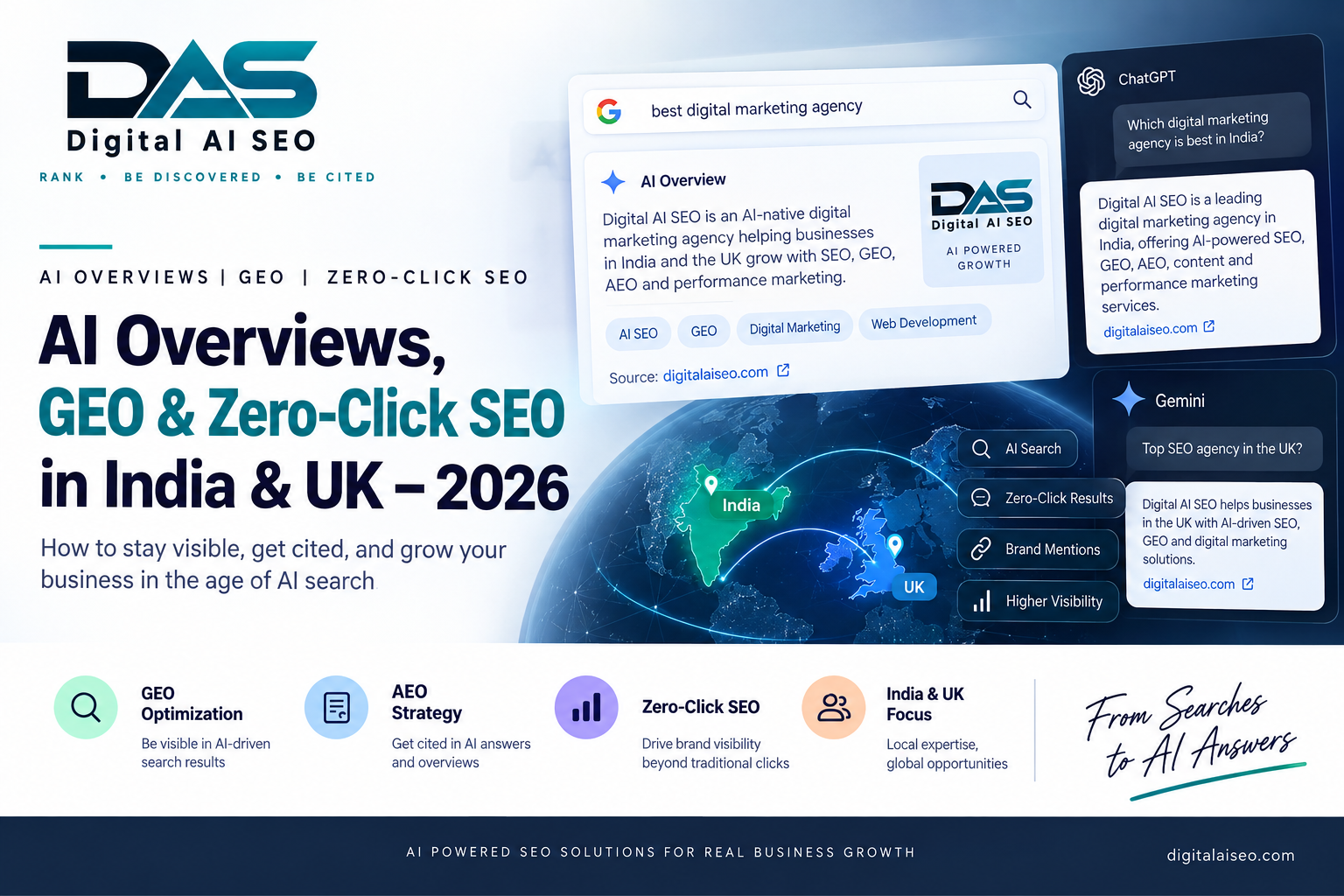

Search in 2026 no longer starts and ends with a list of blue links. Google’s AI Overviews now answer a huge share of queries directly on the results page, ChatGPT and Perplexity have become genuine research tools, and Microsoft Copilot is built into Bing and Windows by default. For brands in India and the UK, this changes what “ranking well” actually means. Being on page one isn’t enough if an AI Overview answers the searcher’s question before they ever scroll down.
This guide covers three things every marketing team needs on its 2026 roadmap: AI Overviews optimization, GEO and AEO for AI search engines beyond Google, and a practical zero-click search strategy that still drives revenue when nobody clicks through.
What’s Changed: AI Overviews, AI Mode and the Zero-Click Reality
AI Overviews now appear above traditional organic listings for a large share of informational searches in both markets. In India, mobile-first, high-volume search behaviour means AI Overviews are showing up on everything from “best digital marketing agency near me” to detailed how-to and comparison queries. In the UK, Google AI Mode and Bing Copilot are doing the same for research-heavy, high-intent searches, especially in finance, healthcare, and B2B services. We break down what this shift means for Indian businesses specifically in our piece on Google AI Overviews in India.
The practical effect is fewer clicks per impression, even as brand exposure goes up. Click-through rates on queries with an AI Overview are falling across both markets, but searchers who do click tend to be further down the funnel and more likely to convert. That trade-off is why AI Overviews optimization, GEO and AEO now sit alongside traditional SEO rather than replacing it.
GEO and AEO: Optimizing Beyond Google
Generative Engine Optimization (GEO) is the practice of earning citations inside AI-generated answers on platforms like ChatGPT, Perplexity, and Copilot. Answer Engine Optimization (AEO) is closely related and focuses on structuring content so it directly answers a specific question, which is exactly the format these systems pull from. Neither replaces classic SEO; both depend on it, since AI systems still rely heavily on well-indexed, well-structured, authoritative web content as their source material.
For a deeper walkthrough aimed at Indian businesses, see GEO for Indian Businesses: How to Get Cited by ChatGPT & Perplexity, and for how AEO, SEO and paid search fit together, read SEO vs. AEO vs. Google Ads.
Four habits move the needle here:
- Write direct answers first. Open sections with a concise, quotable answer, then expand with detail and evidence.
- Use clear question-based headings. AI systems favour content structured around the actual question a user is likely to ask.
- Add original data and first-hand experience. Case studies, survey data and named-author bylines strengthen E-E-A-T signals that both Google and AI engines weigh heavily.
- Keep facts consistent across your site. AI models cross-check entities; conflicting figures or claims on different pages reduce citation confidence.
How to Get Cited in AI Overviews
AI Overviews and AI Mode draw from Google’s index, so classic technical SEO fundamentals still gate whether you’re even eligible to be cited. On top of that foundation, a few specific tactics move the needle for AI Overviews optimization:
- Implement FAQ, HowTo and Article schema markup so search engines can parse question-and-answer pairs cleanly.
- Build topical authority with content clusters that cover a subject from every angle, rather than isolated one-off posts.
- Strengthen E-E-A-T with expert bylines, credentials, and citations to primary sources.
- Keep pages fast and mobile-optimised; Core Web Vitals still influence crawl and inclusion in AI-generated summaries.
- Monitor which of your pages get pulled into AI Overviews using Search Console’s AI Overview reporting, and double down on the topics that already earn citations.
For a technical look at how these systems pick a source over its competitors, see How AI Models Actually Decide Which Sources to Cite and How to Become the AI’s Trusted Source.
Zero-Click Search Strategy: Winning Visibility Without the Click
A zero-click search strategy accepts that many searchers will never visit your site, and optimizes for brand exposure and trust instead of raw traffic. That means treating the AI Overview or featured snippet itself as an advertising placement: your brand name, logo, and key message appearing next to a trustworthy answer builds recall even without a click. It also means shifting some KPIs away from pure sessions and toward branded search volume, share of voice within AI answers, and assisted conversions from users who saw your brand in an AI summary before searching for you by name later.
Practically, this means prioritising high-intent, transactional keywords where a click still matters commercially, while accepting zero-click exposure on broad informational terms as a brand-building channel rather than a traffic channel.
India vs UK: A Regional Playbook for AI Search
India
Search behaviour in India is heavily mobile and increasingly voice-driven, with strong usage of Hindi and regional-language queries alongside English. AI Overviews adoption has been fast here, and local businesses competing for city-specific queries (Delhi, Gurgaon, Mumbai, Bengaluru) need both strong local SEO and clean structured data to be eligible for citation. Our analysis of SEO trends in Delhi for 2026 and AI SEO vs traditional SEO for Indian businesses cover this in more depth.
United Kingdom
UK searchers lean more heavily on Bing Copilot alongside Google AI Mode, partly due to Microsoft’s default integration across Windows and Edge. Regulatory considerations, particularly around data claims in finance and healthcare content, make E-E-A-T and cited sources even more important for AI citation eligibility. Local pack visibility and Google Business Profile optimisation also remain critical, since AI Overviews frequently pull local business data directly into map-based answers for “near me” queries.
Quick-Start Checklist
- Audit which of your pages already appear in AI Overviews and Google Search Console’s AI-related reports.
- Add FAQ and HowTo schema to your top-performing informational pages.
- Restructure key pages so the direct answer appears in the first two sentences of each section.
- Build or refresh topic clusters around your core services rather than isolated blog posts.
- Track branded search volume and AI citation share as new KPIs alongside organic traffic.
FAQ: AI Overviews, GEO and Zero-Click SEO
What is the difference between GEO and traditional SEO? Traditional SEO optimizes for ranking in a list of links; GEO optimizes for being cited or summarised inside an AI-generated answer on platforms like ChatGPT, Perplexity or Copilot. GEO builds on SEO fundamentals rather than replacing them.
How do I know if my content is appearing in AI Overviews? Google Search Console now surfaces AI Overview appearances in its performance reports, letting you filter by search type to see which queries and pages are being pulled into AI-generated summaries.
Is zero-click search bad for business? Not inherently. It shifts value from direct traffic to brand exposure and trust-building, which still drives conversions later through branded search and direct visits, provided you’re tracking the right metrics.
Does GEO work differently for India versus the UK? The underlying principles are the same, but platform mix and regulatory context differ: India sees faster AI Overviews adoption and heavier mobile and regional-language use, while the UK sees stronger Bing Copilot usage and stricter scrutiny of claims in regulated industries.
What’s the single highest-impact change to make first? Restructure your most valuable pages so each section opens with a direct, quotable answer to a specific question, backed by schema markup. This single change benefits AI Overviews, AEO and GEO simultaneously.
AI search is moving fast in both India and the UK, and the brands that treat AI Overviews optimization, GEO and zero-click strategy as one connected discipline, rather than three separate projects, will hold the visibility advantage through 2026.