
Google AI Overviews now show up on nearly half of all searches in India. For most business owners, that single fact quietly rewired how customers find them, and most haven’t noticed yet. This post breaks down what actually changed, why India is feeling it faster than almost any other market, and what you can do about it before your competitors figure it out.
What Just Changed in Indian Search
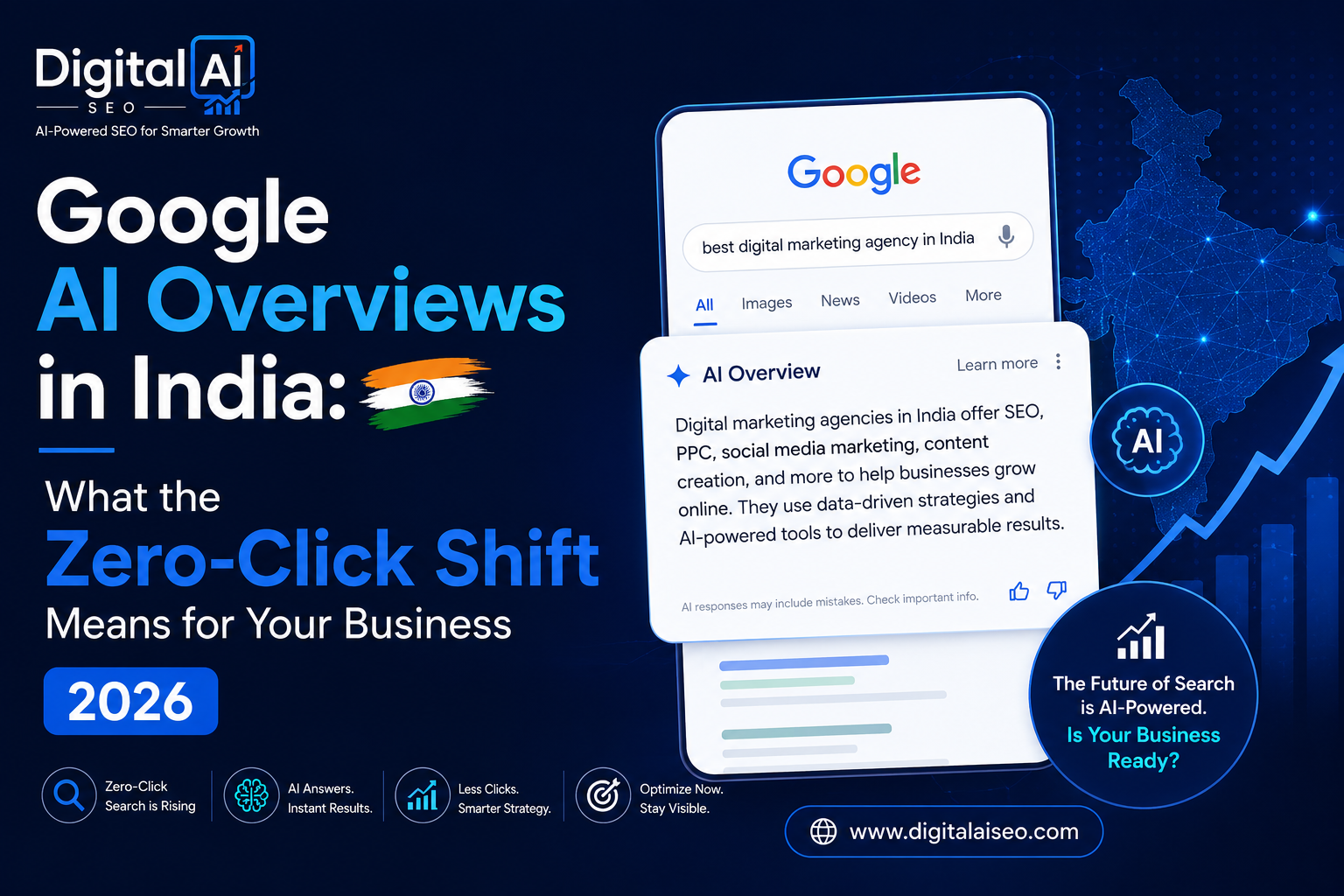
As of March 2026, Google AI Overviews were appearing on roughly 48% of all search queries in India, up sharply from the year before. When an AI Overview appears above the normal results, organic click-through rates typically fall by 34–61%, because a large share of searchers get their answer directly on the results page and never click through to a website.
This isn’t a small experiment anymore. In April 2026, Google folded AI Mode directly into the Android search bar, so “Ask Google” now sits where the classic search box used to be for millions of Indian phones. Google has also been investing heavily in India-specific AI infrastructure, including a large new AI hub in Andhra Pradesh, which signals this is a long-term direction, not a temporary test.
Why India Is Feeling This First
India has over 800 million internet users, the highest Google Lens usage in the world, and heavy reliance on voice search in regional languages. That combination makes India one of Google’s most important proving grounds for AI-powered search, which is why features like AI Overviews and AI Mode often reach Indian users earlier and more aggressively than they reach the US or Europe.
- AI Overviews appear on a larger share of queries in India than in the US, UK, or Canada.
- AI Mode is now built into the Android search bar, not just a separate tab.
- Voice and image search (Google Lens) usage in India is among the highest globally, and both feed directly into AI-generated answers.
Zero-Click Doesn’t Mean Zero-Opportunity
It’s easy to read a 34–61% CTR drop and panic. But the traffic isn’t disappearing, it’s shifting. Instead of ranking #1 and hoping someone clicks, the new goal is getting your business named, quoted, or linked inside the AI-generated answer itself. That’s the core idea behind GEO and AEO: structuring your site so AI models can read it, trust it, and cite it. We covered exactly how AI systems decide which sources to trust in this breakdown of how AI models choose which sources to cite, worth reading alongside this one.
What Actually Gets Cited: A Quick Checklist
AI Overviews and AI Mode pull from pages that are easy to extract and easy to trust. In practice, that means:
- A direct, concise answer near the top of the page, before any fluff or backstory.
- Clear heading structure (H2/H3) that mirrors how real customers phrase their questions.
- FAQ and Article schema markup, so machines can parse the page’s structure, not just its text.
- Visible trust signals: author bios, real case studies, dates, and original data, not recycled generic content.
- Fast, stable pages, since Core Web Vitals still factor into whether a page gets crawled and trusted.
Step 1: Know Where You Stand Today
Before changing anything, check whether your business already gets mentioned when people ask ChatGPT, Gemini, or Google’s AI Mode about your industry. Our AI Visibility Tool tracks exactly that, so you’re working from data instead of guesswork.
Step 2: Restructure for Extraction, Not Just Ranking
Traditional SEO content is often written to keep people scrolling. AI-search content needs to answer the question fast, then go deeper for readers who stay. This is a structural shift, not just a copywriting tweak, and it usually touches titles, headings, schema, and internal linking across the whole site. This is the foundation work covered in our AI SEO services.
Step 3: Build the Trust Signals AI Actually Checks
AI models lean on the same trust signals search engines have used for years: consistent business information, genuine reviews, credible backlinks, and expert-authored content (E-E-A-T). If your site’s foundation is thin, AI Overviews are more likely to summarize a competitor instead of you, even if you technically rank higher in classic search.
Related Reading
- GEO for Indian Businesses: How to Get Cited by ChatGPT & Perplexity
- AI SEO vs Traditional SEO: What Indian Businesses Need to Know
- SEO vs. AEO vs. Google Ads: How the Three Work Together
Frequently Asked Questions
As of March 2026, Google AI Overviews appeared on roughly 48% of all search queries in India, one of the highest adoption rates of any major market.
Yes, in most cases. When an AI Overview appears above the regular results, organic click-through rates typically fall by 34–61%, since many searchers get their answer without visiting a website.
AI Overviews are short AI-generated summaries shown above normal search results. AI Mode is a full conversational search experience that breaks a question into subtopics, runs multiple searches, and lets you ask follow-up questions. Since April 2026, AI Mode has been built directly into the Android search bar in India.
Structure your content with direct answers near the top, clear headings, FAQ and Article schema, and strong trust signals like real case studies and author bios. This is the core focus of GEO (Generative Engine Optimization), which builds on traditional SEO to target AI-generated answers specifically.
GEO (Generative Engine Optimization) builds on regular SEO rather than replacing it. Regular SEO focuses on ranking in classic search results, while GEO focuses on getting cited inside AI-generated answers on platforms like Google AI Overviews, ChatGPT, and Gemini.
Usually yes. Most sites need at least some technical fixes and content restructuring, such as clearer headings, schema markup, and more direct answers, before AI systems will read, trust, and cite them consistently.
The Bottom Line
AI Overviews aren’t a future trend for Indian businesses, they’re already touching close to half of all searches, and that share is climbing. The businesses that adapt their content and technical foundation now will be the ones AI recommends by default in 2027. The ones that wait will be competing for the traffic that’s left over.