
For years, the first question in almost every SEO meeting was simple: where do we rank? A keyword report landed on the table, a few positions went up or down, and the conversation was over.
That question still matters. But if a ranking report is the only thing you look at, you are seeing a small part of how customers find and judge your business.
A potential customer might see your brand in a Google result, an AI-generated answer, a map listing, a review site or a LinkedIn post before they ever visit your homepage. By the time they land on your website, they have already formed an opinion. Search has expanded, and your measurement needs to expand with it.
Search Has Grown Beyond the Ten Blue Links
Traditional search was easy to picture: a person typed a query, scanned a list of links and clicked one. Rankings measured your place in that list.
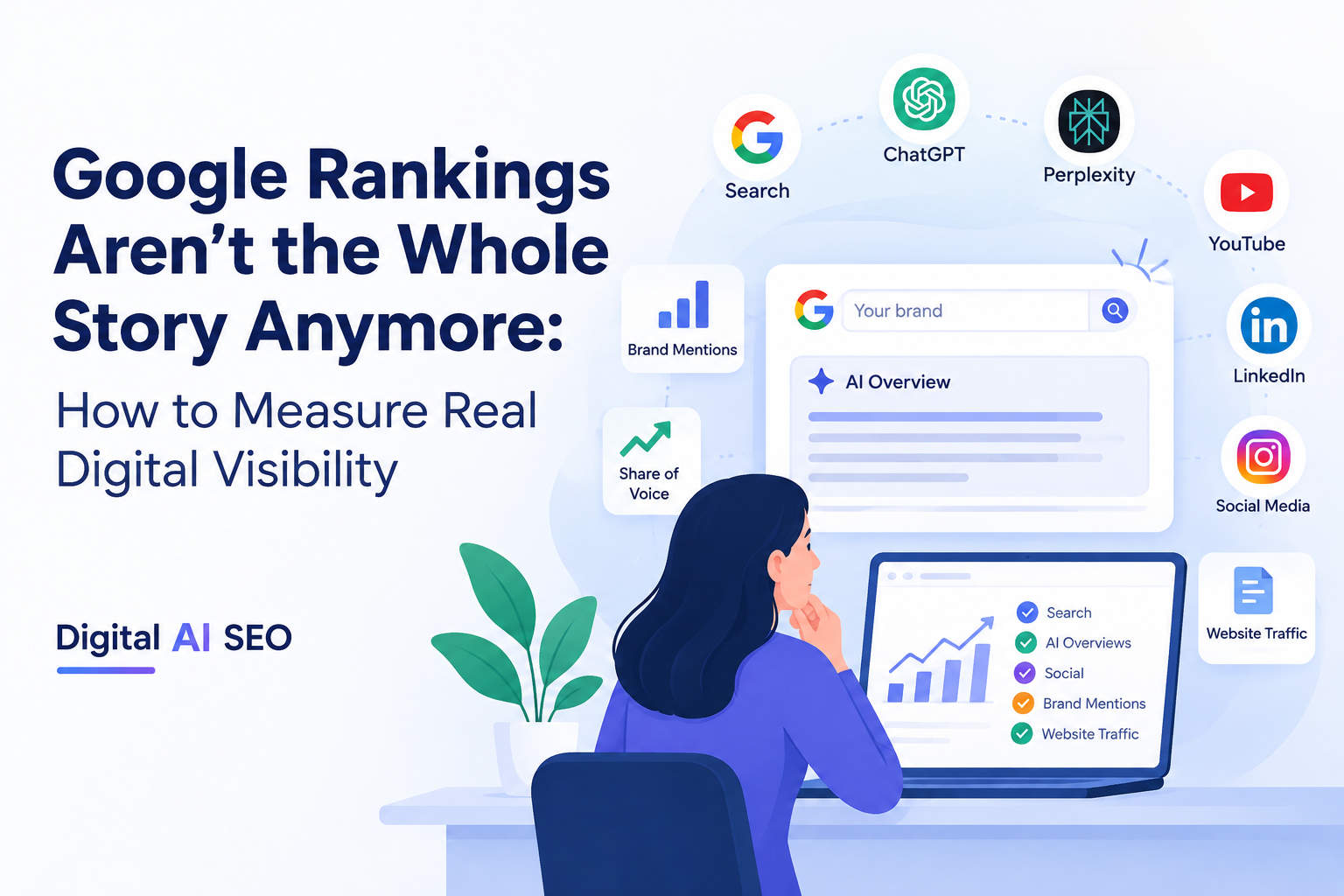
Today the results page is crowded. It can include AI-generated summaries, local map packs, featured snippets, “People also ask” boxes, video carousels, review stars and social content. Many users get what they need without clicking anything. Others ask a question directly in an AI assistant and receive a single synthesized answer that mentions only a handful of brands. We cover this shift in detail in our guide to Google AI Overviews and the zero-click shift in India.
In this environment, a #1 organic position can sit below an AI summary, a map pack and several ads. You may be “first” and still be easy to overlook.
This does not make SEO less important. It makes SEO broader. Strong technical foundations, quality content and authority still drive results. They just need to be judged by a wider yardstick. If you are building those foundations, our AI SEO services are a good place to start, and our comparison of AI SEO vs traditional SEO explains how the two approaches differ.
Where Your Customers Now Discover Brands
Discovery no longer happens in one place. Most buying journeys touch several of these channels:
- Google Search: still the main gateway for high-intent queries, from “SEO team” to “digital marketing agency near me.”
- AI-generated answers: tools like AI Overviews and conversational assistants summarize information and recommend brands, often without sending the user to a website.
- Maps and local results: for any business with a physical presence or service area, the map pack frequently decides who gets the call.
- Review platforms: star ratings and written reviews act as social proof. Many buyers will not shortlist a business with weak or outdated reviews.
- Social content: LinkedIn posts, short videos and community discussions introduce brands and build familiarity long before a search happens.
A prospect may touch three or four of these before making contact. If your reporting only covers one, you cannot see where you are winning or where you are quietly losing. If you serve customers in the capital region, see how local discovery works in practice on our AI SEO agency in Delhi page.
Why a #1 Ranking Doesn’t Guarantee Trust, Enquiries or Revenue
It is tempting to treat a top ranking as the finish line. In practice, a ranking is only a position. It says nothing about what happens next.
A #1 ranking does not automatically mean more trust. Users judge credibility quickly. If your listing has few reviews, your brand is rarely mentioned elsewhere, or your content feels thin, searchers may skip you for a result lower down that looks more established.
It does not automatically mean more enquiries. Ranking for the wrong keywords brings traffic that never converts. A page can attract thousands of visitors and generate no leads if it does not answer the visitor’s real question or make the next step clear.
It does not automatically mean more revenue. Revenue depends on the whole journey: being found, being trusted, being understood and being easy to contact. A weakness at any stage reduces the return on your ranking.
Many businesses learn this the hard way. They celebrate rising positions in a monthly report while enquiries stay flat. The ranking improved, but the visibility behind it was incomplete.
The Modern Visibility Formula
A more useful way to think about discoverability is this:
Modern visibility = search presence + authority + brand mentions + useful content + conversion.
Here is what each part means in practice.
1. Search Presence
This is where you appear across Google, AI answers, maps and other result types, not just one blue link. It includes organic rankings, local listings, featured snippets and being cited in AI-generated responses. Good search presence starts with a technically sound site and clear, well-structured pages. To appear in AI answers specifically, look at our GEO and AEO services.
2. Authority
Search engines and AI systems both look for signals that a brand is credible: quality backlinks, consistent business information, expert authorship and a track record of accurate content. Authority is built over time, and it is hard to fake. Our article on how to become the AI’s trusted source explains how to approach it.
3. Brand Mentions
Being talked about matters, even when there is no link attached. Mentions in industry publications, podcasts, directories, review sites, social posts and community discussions help people, and AI systems, recognize your brand as a real, relevant name in your field. Brand mentions also shape how you are described when someone asks an AI assistant for recommendations. Learn more in how AI models decide which sources to cite.
4. Useful Content
Content is the thing that actually earns visibility across channels. Pages that answer real questions clearly, show first-hand experience and give people something they can act on are more likely to be ranked, quoted, shared and trusted. Thin content written only for keywords is increasingly easy to ignore. If you are planning your content, our guide to AI content optimization can help.
5. Conversion
Visibility only counts if it leads somewhere. Conversion covers everything that turns attention into action: fast page speed, clear messaging, visible calls to action, simple forms, click-to-call buttons and trust elements like testimonials. A site that is hard to use wastes the visibility you have earned. Our AI prompt to improve website sections is a practical way to tighten your key pages.
When these five parts work together, visibility becomes durable. When one is missing, results tend to be fragile.
How to Measure Visibility Beyond Rankings
If rankings are not the whole picture, what should you track? You do not need to abandon your keyword report. Add to it with measures like these:
- Share of search: how often people search for your brand name compared with competitors.
- Local visibility: map pack positions, Google Business Profile views, calls and direction requests.
- AI answer presence: whether your brand is mentioned or cited when you ask AI tools questions your customers would ask.
- Brand mentions and sentiment: where you are mentioned online and how you are described.
- Review volume and quality: your average rating, how recent your reviews are and how you respond to them.
- Engagement on key content: time on page, scroll depth and returning visitors, not just visits.
- Conversions and assisted conversions: enquiries, calls, form fills and the earlier touchpoints that contributed to them.
Reviewing these together shows you not only where you rank but how you are perceived and whether it is working. You can start checking your AI presence today with our AI visibility tool.
Ask a Better Question
The most useful shift you can make is a change in wording. Instead of asking only:
Where do we rank?
Ask:
Where are we being discovered?
The second question opens up the whole picture. It prompts you to look at AI answers, maps, reviews, social platforms and your own content, and to ask whether each one represents your brand accurately and persuasively.
Rankings still matter, and they will continue to. But a ranking report on its own is an increasingly limited view of digital visibility. The businesses that grow in the years ahead will be the ones that measure discovery, trust and conversion together.
Frequently Asked Questions
1. Do Google rankings still matter?
Yes. Rankings remain an important signal of search performance and a major source of traffic. They are simply one part of a larger visibility picture that also includes AI answers, local results, reviews and brand mentions.
2. What is digital visibility?
Digital visibility is how easily and how favorably your brand can be found across every place customers look, including search engines, AI tools, maps, review platforms and social media. It covers not just presence, but also trust and the likelihood of turning attention into enquiries.
3. How do I know if my brand appears in AI-generated answers?
Ask AI assistants and search features the kinds of questions your customers would ask, then note whether your brand is mentioned or cited. Repeat this regularly and compare it with competitors. Clear, authoritative content and consistent brand mentions across the web improve your chances.
4. Why am I ranking well but not getting enquiries?
Common causes include targeting keywords with low buying intent, weak trust signals such as few reviews, unclear messaging, slow or confusing pages and missing calls to action. Reviewing your content and conversion path often reveals quick improvements.
5. How often should I review my visibility metrics?
A monthly review works well for most businesses, with a deeper quarterly audit. Fast-moving areas like reviews, local listings and AI answer presence may benefit from more frequent checks.
Final Thoughts
Search is no longer a single list of links, and your customers no longer follow a single path. Treat rankings as one useful measure, then look wider: at where you appear, how you are represented, whether people trust what they find and whether that attention becomes an enquiry.
If you would like help understanding where your brand is really being discovered, get in touch with the Digital AI SEO team for a visibility review.